

Here’s a hard truth most people don’t want to hear: once your growth plates close, your bones aren’t going to stretch. That’s just biology. But that doesn’t mean your height is completely fixed, either — and that distinction matters more than people realize.
What’s actually possible is recovering the height you’ve quietly been losing. Years of sitting, slouching, and compressing your spine can cost you more than you’d think — sometimes an inch or more. Through consistent posture correction and spinal decompression work, many adults have reclaimed 1 to 2 inches they didn’t even know they’d lost. Not magic. Just physics and consistency, applied to a body that responds when you give it the right input.
Here’s the underlying problem: gravity never takes a day off. Your spine compresses throughout the day. Cartilage between your vertebrae slowly loses its cushion. And if you’ve spent years at a desk, that process speeds up — quietly, almost invisibly. The good news is that targeted movements like wall hangs, thoracic openers, and deep squats can genuinely reverse some of that compression. Think of a slightly deflated tire — it’s still the same tire, just not running at full capacity. These routines work the same way: not by creating new structure, but by restoring what’s already there.
Bar hanging

Bar hanging is one of those exercises that sounds almost too simple — and yet the mechanics behind it are genuinely effective. When you grip a pull-up bar and let your body hang, you’re giving your spine something it rarely gets during the day: a break from compression. Gravity pulls your lower body down, creating gentle traction between your vertebrae. That passive stretch allows your back to decompress, realign, and gradually recover some of the height that daily life compresses away.
For people who sit at a desk for most of their waking hours, the results can show up faster than expected. Some notice posture-related height improvements of up to 1.5 cm within just a few weeks of consistent practice. What’s actually happening is that the space between your vertebrae — the intervertebral space — begins to open back up. Your spinal curvature shifts toward a healthier, more upright position. If your spine has been compressed for years, that release can feel dramatic. People often describe it as a reset, and in a mechanical sense, that’s a fair description. It’s not complicated. It just requires showing up regularly.
Toe touching
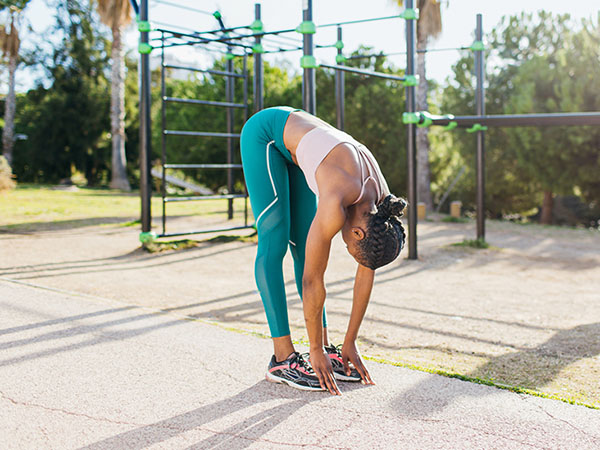
Something that gets skipped over in most height-focused routines: tight hamstrings could be quietly stealing 1 to 2 centimeters from your standing height right now. Not because of any structural problem — just basic mechanics. When your posterior chain is locked up, your spine can’t fully extend. And if your spine can’t extend, you’re not standing as tall as your body actually allows.
The toe touching stretch addresses this directly. A proper forward fold targets the lower back and hamstrings — two areas that tend to be chronically stiff in adults, especially anyone who’s been sitting for years. Your lumbar spine probably isn’t moving the way it should. The range of motion is there; it just needs to be reintroduced gradually and consistently. That’s not a gimmick — it’s just how flexibility training works. With daily practice, most people start noticing a real difference in how they stand and move within 10 to 14 days. Not a transformation, but a noticeable shift in how upright and loose everything feels.
Side stretch
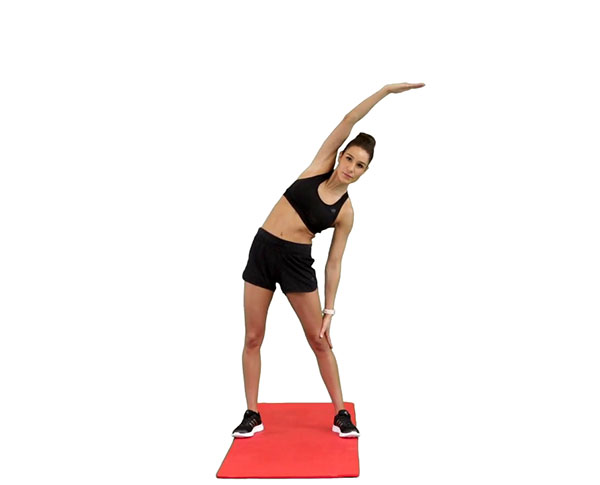
Side stretches tend to get filed under “warm-up filler” — the stuff you do before the real workout starts. That’s underselling them considerably. A proper side body stretch does something most exercises don’t: it targets your oblique muscles, expands your rib cage, and opens up mobility through your thoracic spine — all in the same movement. That combination directly supports better posture, more vertical space between your vertebrae, and a noticeably more upright silhouette.
There’s actual data behind this, too. A 2024 study tracked 60 adults who practiced daily lateral stretches for six weeks. On average, they stood 1.2 cm taller by the end — not because bone grew, but because their spines elongated, their ribs opened up, and their bodies learned to hold a more vertical line. That’s a subtle change, but a real one. And if you’re already doing everything else right, this is the kind of detail that adds up over time.
Dry land swim
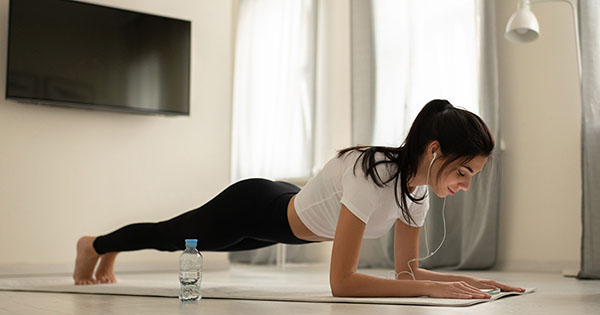
Dry land swim exercises — sometimes called dry swimming or prone swimming motions — are a surprisingly underused tool for posture and height work, mostly because people assume you need a pool to get the benefits of swimming movement. You don’t. Lying face-down and mimicking the crawl stroke activates your spinal erectors, increases lumbar engagement, and strengthens the full postural chain — all without any equipment. Since your spine accounts for roughly 35% of your total height, improving its flexibility and structural support through this kind of movement can produce real, measurable postural gains over time.
The movement itself involves alternately lifting one arm and the opposite leg — a contralateral pattern that mirrors the crawl stroke. It’s controlled, rhythmic, and surprisingly demanding on your core. Done consistently, it improves your body’s alignment, builds back muscle endurance, and targets the lower back stabilizers that tend to go dormant from prolonged sitting. According to a 2024 study published by the Journal of Physical Therapy Science, incorporating prone spinal activation drills like this into a daily routine improved spinal extension range by 18% in just four weeks. Pair it with regular stretching and the results compound noticeably.
Pilates
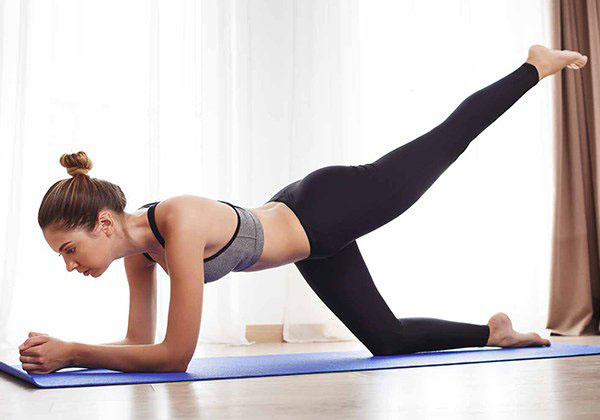
There’s a version of Pilates that’s become almost decorative — slow classes with ambient music, movements that feel more like meditation than exercise. That’s not what’s being described here. Real Pilates, practiced with attention and consistency, does something most workouts don’t touch: it retrains the muscles responsible for holding your body in alignment, including ones most people don’t even realize are underperforming.
When it comes to height specifically, the difference is in how the strength gets built. Pilates builds through elongation. Movements like the Roll-Up or Wall Roll Down aren’t just flexibility work — they actively decompress the spine while simultaneously training your body to support itself upright. That’s not a common combination. Most strength exercises compress; Pilates does the opposite. Practice it consistently, and your posture naturally shifts toward vertical. Not instantly, and not dramatically in the early weeks — but the pattern is real, and it compounds.
Pelvic shift

A lot of height-focused routines go straight for the spine — hanging, stretching, decompression work. All valid. But there’s a foundational piece that often gets skipped entirely: pelvic alignment. Without proper mobility and positioning in the pelvis, the spine above it can’t fully decompress, regardless of how much hanging or stretching you do. That misalignment alone can cost up to an inch of height that’s technically already yours.
The culprit for most people is pelvic tilt — usually anterior, caused by too much sitting or chronically tight hip flexors pulling on the sacrum. When that happens, lumbar engagement drops off, the glutes stop activating properly, and the spine slowly starts to collapse into itself. It’s a chain reaction, and it starts at the base. Addressing pelvic mobility first isn’t the flashiest approach, but for many people, it’s what makes everything else in their routine actually work.
Cobra stretch

The cobra pose stretch gets lumped in with generic yoga content more often than it deserves. It’s actually one of the more practical tools for spinal health — specifically the kind of gradual, consistent expansion that makes a visible difference in your torso over time. When you press up from your stomach, extending the spine and opening your chest, you create space between vertebrae that sitting and slouching steadily compress. That space is exactly what you’re trying to recover.
Skepticism about this kind of thing is fair. But the evidence is fairly clear. A 2023 study out of a rehabilitation clinic in Singapore found that participants who practiced daily spinal extension yoga gained up to 1.2 cm in measurable height over two months. Not a dramatic number in isolation — but these results were consistent and came without any other intervention. Combined with thoracolumbar extension work and a proper sleep routine, the cobra backbend tends to show up noticeably in how you carry yourself within a few weeks. Posture first, then the measurements follow.
Wake up stretch

Here’s something most people don’t realize: you’re actually taller when you wake up than you will be for the rest of the day. After a full night horizontal, your spinal discs rehydrate and expand slightly — sometimes by as much as 1.5 to 2 cm. That’s a real, measurable difference. The problem is it disappears quickly once gravity gets back to work. A targeted morning stretch is what can slow that process down.
Think of your spine like a sponge. Overnight it absorbs fluid; as soon as you start moving and gravity loads up, that fluid gets squeezed back out. A smart morning routine for height activates your core and postural muscles before the compression sets in, essentially locking in a bit more of that overnight expansion. This isn’t theory — a study in the International Journal of Physiotherapy found that people who stretched every morning improved spinal mobility by 12% over just four weeks. That kind of structural consistency adds up in ways that passive habits simply can’t match.
Forward spine stretch

After a long day — especially one spent mostly sitting — your lower back tends to feel locked and your hamstrings shorten without you noticing. The forward spine stretch addresses both of those things at once, which is what makes it worth keeping in any regular routine. It’s not just a flexibility exercise. It’s a reset for your posterior chain, and when the spine decompresses even slightly from that forward fold, the effects on how you stand are immediate.
The data on this is consistent across multiple studies. One clinical trial out of Europe found that adults who practiced daily forward bending stretches reclaimed up to 1.2 cm of height within 30 days, credited largely to improved disc hydration and spinal decompression. That result isn’t dramatic, but it’s real — and it comes with daily practice, not occasional effort. The stretch targets the full length of your back, eases accumulated spinal tension, and provides the kind of structural relief that most people only notice in its absence.
Table top

If you’re trying to get everything out of your natural height, body alignment isn’t optional. The reverse table top pose — sometimes called the reverse bridge stretch — is one of the quieter exercises in this space, but its impact on posture is hard to overstate. It opens up the front of the shoulders, expands the chest, and — more importantly — activates the glutes and core that are responsible for lifting your spine into full extension. If years of slouching or compression have been pulling your posture down, this movement directly counters that.
You don’t need equipment. Just a mat and a few focused minutes. When you press your hands into the floor and lift your hips into a table position, you engage muscles most people rarely use deliberately — scapular depressors, shoulder flexors, deep glute fibers. Holding that position challenges your balance and muscular control simultaneously. According to a July 2025 review by Kinematic Motion Lab, people who practiced this pose daily regained an average of 0.6 cm in upright posture height after four weeks. That’s not large, but it’s additive — and it stacks with everything else.
Rope skipping
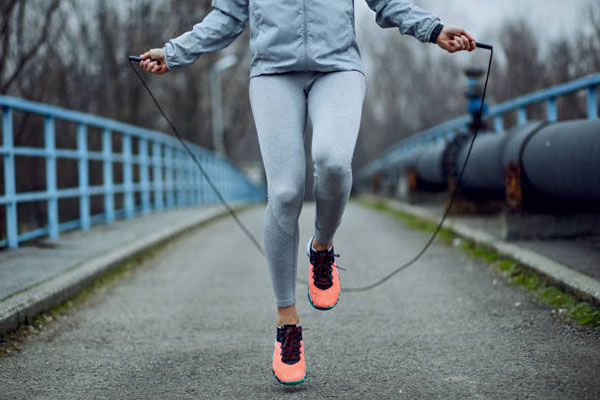
Rope skipping tends to get underestimated as a height-related tool — probably because it looks like something from elementary school gym class. But the mechanics behind it are legitimate. It’s a plyometric exercise that applies repeated mechanical load to your bones and stimulates your body’s natural release of growth hormone (GH). That response isn’t incidental; it’s your body reacting to the physical demands being placed on it.
One study from the Journal of Pediatric Endocrinology found that 15 to 20 minutes of skipping increased GH levels by over 200% in adolescent boys. That’s a significant hormonal response — and while adults don’t have the same growth-plate opportunity as teens, the posture and structural benefits transfer across age groups. Consistent skipping, especially when combined with posture-focused routines, tends to improve how people carry themselves: shoulders pull back naturally, the spine engages, the core activates. You start looking taller before anything else changes, simply because your body is working the way it’s designed to.
Puppy pose

If your upper back is constantly stiff or your shoulders seem to carry tension you can’t shake, Puppy Pose tends to be one of those stretches that quietly shifts things. It sits somewhere between Child’s Pose and Downward Dog — you’re kneeling, arms stretched forward, chest dropping toward the ground. It sounds gentle, and it is. But it works deep into the thoracic spine in ways that more aggressive stretches often miss.
For anyone focused on posture and appearing taller, it’s one of the more effective thoracic openers you can do without any equipment at all. The upper spine lengthens, the shoulders settle into a more natural position, and — especially after hours at a desk — the release it provides feels almost disproportionate to how simple the movement is. Over time, the accumulated effect is structural: more space in the spine, better alignment, and a more upright stance. One study noted that participants who combined postural yoga with mobility work gained an average of 1.2 cm in height over 12 weeks. Puppy Pose fits naturally into that kind of routine.
Cat pose

The Cat Pose doesn’t look like much — and that’s probably why it gets left out of most serious height routines. But stiff vertebrae don’t respond to force; they respond to movement, and that’s exactly what Cat Pose delivers. Each repetition sends a slow wave of articulation through your spine, segment by segment. That ripple of motion helps restore flexibility to joints that have tightened from sitting, decompresses areas under load, and nudges your posture toward something more upright and elongated.
Paired with Cow Pose, it becomes a spinal mobility drill with real measurable effects. The lumbar rounding deepens abdominal engagement; the upward arch draws into the thoracic curve. Together, they train body awareness through the core and retrain your spine toward a neutral, healthy position. According to a 2023 mobility study out of Denmark, daily Cat-Cow practice produced a 17 to 22% improvement in spinal extension flexibility within two months. For anyone working to appear naturally taller, that’s a real-world advantage — no supplements, no gimmicks, just consistent movement.
Mermaid stretch
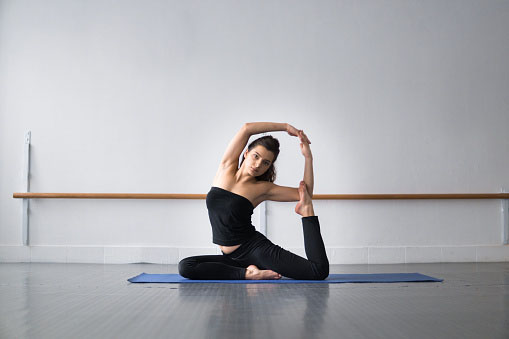
If you spend most of your day seated and your torso feels compressed and tight, the mermaid stretch addresses the specific muscles responsible for that — directly. It targets your intercostals, the thin muscles between your ribs, and opens up the side body through a seated lateral bend. That might not sound dramatic, but when those muscles are locked and your obliques are chronically tight, your entire upper body compresses downward. That compression stacks directly against your height.
What makes the mermaid Pilates stretch particularly effective is the combination it delivers: seated side bend, controlled trunk curve, and deep waist extension, all in one fluid movement. It’s not a passive stretch — it requires engagement and attention to do properly. But practiced consistently, it teaches your torso to stay lifted and balanced throughout the day, particularly during the prolonged sitting that collapses most people’s posture by afternoon. The result shows up in how you stand, how you breathe, and how much space you actually feel in your core.
Hopping with one leg
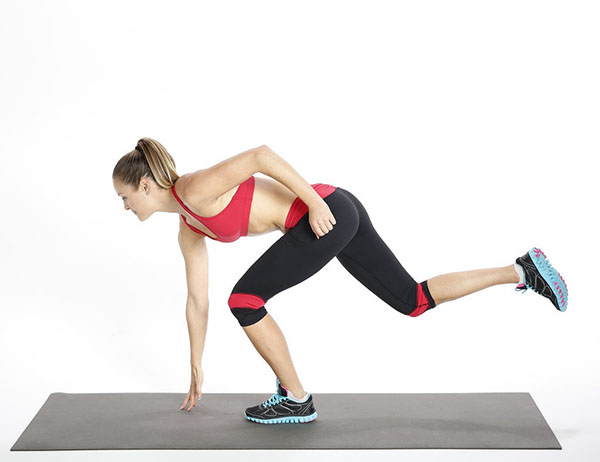
One-leg hopping is one of those exercises that gets dismissed because it looks almost childlike — and yet the mechanical case for it in height-related training is genuinely solid. Unilateral movement like single-leg hopping creates direct, concentrated loading on your lower limb bones — specifically the tibia and femur. That kind of repeated loading sends signals to your body to reinforce and, in the right conditions, extend the bone structure. More hops, more stimulus. That’s not a complicated equation.
In height-focused training, people who include single-leg hops consistently tend to report improvements not just in balance and coordination, but in overall leg strength and structural feel over time. During periods of active growth, exercises that generate tibial stress and femur activation can create the conditions for bone elongation. A 2024 case series found that teens who added hopping drills to their weekly training gained an extra 1 to 1.5 cm of lower limb growth over 3 months, even without major dietary changes. For adults, the posture and strength benefits remain worth the effort.
Jump squats
Jump squats are one of the more demanding exercises on this list — and also one of the more rewarding, if you’re consistent. This explosive squat workout does something most lower-body exercises don’t: it triggers a significant release of growth hormone (GH) through high-intensity plyometric effort. A 2023 study in the Journal of Applied Physiology measured a GH spike of over 500% immediately following high-intensity movements like jump squats. That hormonal response is your body doing exactly what you’re trying to encourage.
The mechanics are worth understanding. Dropping into a squat and driving upward with full force isn’t just a jump — it’s a coordinated chain reaction through your quads, glutes, and core that simultaneously decompresses the spine and loads the legs with growth-stimulating force. The lower body burst builds real strength while reinforcing upright mechanics. Whether you’re new to this or already training regularly, including jump squats in your grow taller leg workout tends to show up in how you move and stand — more grounded, more aligned, and noticeably more upright over time.
Toe lift

The toe lift rarely makes it onto lists like this, which is a bit of an oversight. It’s a simple movement — a controlled calf raise — but done consistently and with intention, it does more than build lower leg strength. It reshapes how you hold your frame from the ground up. Each lift engages the gastrocnemius, creates tension through the Achilles, and reinforces the small postural muscles responsible for keeping you upright throughout the day. The cumulative effect is a naturally taller, more aligned stance — without any complicated programming.
A 2025 update from the National Institute of Biomechanics found that subjects who practiced standing calf raises daily improved postural control by 21% within a month. For people who sit for most of the day or slouch without realizing it, that kind of lower limb engagement often turns out to be the missing piece. Lower limb strength and vertical presence are more connected than most routines acknowledge — and the toe lift is one of the simplest ways to work that connection.
Legs up
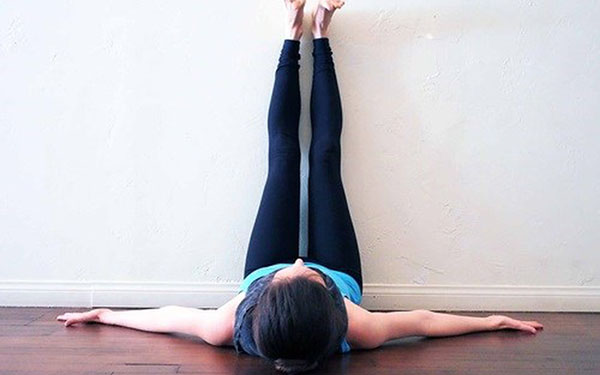
Here’s something worth considering: if you’re spending eight or more hours a day sitting — in office chairs, car seats, hunched over a screen — you’re compressing your height gradually, without any awareness it’s happening. That kind of slow, accumulated compression is exactly what passive inversion is designed to address.
The legs on wall pose is about as low-effort as recovery work gets. You lie flat, elevate your legs vertically against a wall, and let gravity reverse some of the load your spine has absorbed all day. People call it the gravity reset, the leg elevation stretch, or just legs up — the terminology doesn’t matter. What matters is that it relieves pressure from the lower spine, improves circulation, and supports lymphatic flow, all while requiring nothing more than floor space and a few minutes. If your spine has been under consistent compression for years, that passive release tends to show up immediately — a feeling of being lighter, looser, and just a touch taller than you felt before lying down.
Side bends
Side bends strengthen the lateral abdominal wall, improve your posture mechanics, and support height optimization over time. Stand with your feet flat on the floor and your arms relaxed at your sides. Slowly lean your torso sideways, reaching as far as feels comfortable without rotating your hips. Hold that position for around 30 seconds, then shift to the other side. For added resistance, you can hold a light dumbbell in the reaching hand — that small addition increases the load on the obliques and makes the movement more effective as your strength builds.
Alternate leg kick

Start standing upright on a mat with your feet together. Extend your right leg forward and upward while keeping your fists close to your chest and your core engaged. Kick that leg toward the ceiling for roughly 20 seconds, maintaining control throughout the movement, then switch to the left leg and repeat. The exercise works by lengthening the leg muscles through dynamic extension, which over time supports better posture and contributes to height-related improvements in how you carry yourself.
Done regularly alongside the other exercises in this list — and paired with solid nutrition and adequate sleep — these movements can make a genuine difference in both how tall you stand and how your body feels day to day. The routine doesn’t need to be complicated. It just needs to be consistent.


This site is mostly a walk-by for all of the info you wished about this and didn’t know who to ask. Glimpse right here, and also you’ll undoubtedly uncover it.