

You’ve probably heard it in the gym, on YouTube, or maybe from that one guy who swears by bro science: “Lifting stunts your growth.” Or maybe the reverse — “Deadlifts will stretch your spine and make you taller.” Either way, the whole conversation around bodybuilding and height is packed with myths that just won’t die.
So let’s get this straight. If you’re hitting the gym during your teenage years, especially while you’re still in puberty, your growth plates (epiphyseal plates) are still open. That’s where real height growth happens. And no, proper resistance training doesn’t mess with them — unless you’re training like a maniac with no form or supervision.
Real Talk: According to a 2023 study published by the American Academy of Pediatrics, supervised strength training doesn’t impair growth in adolescents — not even close.
What Is Bodybuilding Really Doing to Your Body?
Bodybuilding isn’t just about building muscle—it’s changing the way your entire frame works, from the way your muscles grow to how your bones and joints handle pressure. When you hit the gym regularly and push through resistance training, you trigger hypertrophy in your muscles, which is the technical way of saying your muscle fibers grow thicker and stronger. But the real secret? Your bones are reacting too. Each time you rack up reps under a barbell, you’re putting your skeleton under stress—what’s called skeletal load. In response, your bones adapt by getting denser and more resistant to injury.
Hypertrophy vs. Skeletal Growth
Here’s where things get interesting: muscle growth and bone strengthening don’t happen at the same speed. Your muscles respond relatively quickly to consistent training, especially with a good diet and rest. But bones and tendons? They’re slower. While your arms might bulk up after a couple of months of lifting, your joints and connective tissues are still playing catch-up. This delay can create tension in areas like your knees, elbows, or lower back—especially if your form is off or you’re stacking weight too fast.
- Muscles grow through repeated overload, causing fibers to repair and thicken.
- Bones adapt to weight-bearing stress, reinforcing density in areas like the spine and hips.
- Joints take longer to adapt, making proper form and rest days crucial.
According to recent data from the American Journal of Sports Medicine, lifters who incorporated periodized resistance training—structured increases in intensity and recovery—reduced joint pain by 32% over six months compared to those who trained at random.
Strength Training and Joint Load
The real wear-and-tear in bodybuilding isn’t the muscle soreness—it’s the joint stress. When you load up your squat or deadlift, you’re placing serious compression forces on your spine, hips, and knees. That’s not necessarily bad, unless you’re skipping warmups, lifting with poor alignment, or ignoring recovery. Tendons and ligaments, which connect muscles to bones, rely on progressive stress to grow stronger—too much too soon, and they fray or tear.
Beginner lifters especially need to watch for:
- Shoulder strain from overhead pressing without scapular control
- Knee pain from deep squats without glute engagement
- Lower back tightness from deadlifting with a rounded spine
Even seasoned lifters on forums like r/GYM and Bodybuilding.com say they underestimated the importance of mobility work—until it was too late. One trick that keeps showing up? Add isometric holds and eccentric training into your routines to help tendons catch up with muscles.
July Pro Tip: For better joint support, add band-resisted warmups before push/pull workouts—this primes the tendons and reduces strain under load.
At the end of the day, if you’re chasing gains without understanding what’s really happening inside your body, you’re setting yourself up for setbacks. Bodybuilding doesn’t just sculpt your frame—it rewires how your musculoskeletal system handles stress. Respect that system, and it’ll carry you further than any PR ever will.

Ready to grow taller? Discover proven height supplements at NuBest.com.
Which bodybuilding exercises are helpful for height increase?
By initially performing multi-joint bodybuilding exercises, you will safely strengthen your bones, muscles, joints, and tendons. But before diving into each exercise, you need to know these things.
- About sets/reps: Start 1 set with 8 to 10 reps for the first workout and then perform 2 sets to gain endurance and strength.
- About rest between sets: about 1 minute
- About rest between exercises: about 1 to 2 minutes
Sit, stand, run combo
This combo combines all kinds of different muscle groups while also enhancing your endurance.
- Be in a seated position on the floor.
- Slightly bend your knees while placing your hands on the floor.
- Explode to your feet and run in place for 5 to 10 seconds.
- Sit back down and repeat.
Wall squats with a physioball

This exercise helps strengthen core muscles, yet not for building lower-body strength.
- Grab a physioball and choose a flat wall.
- Put the ball against the wall and stand up straight against it.
- Slowly lower your body into a squat position.
- Pause for 1 second when your thighs are parallel to the floor.
- Turn back to the standing position and repeat.
Single-leg squats
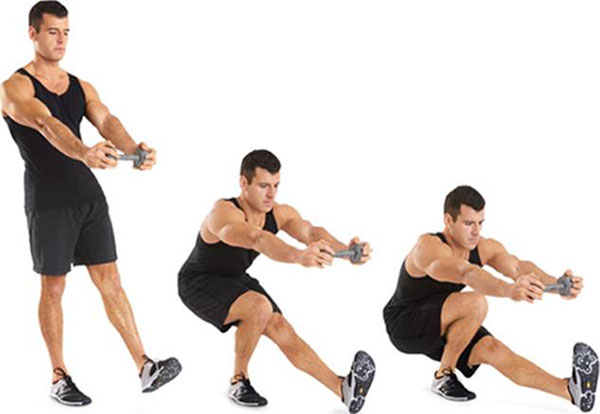
Performing this position is an ideal way to develop balance, strength, and coordination while also lowering the pain in the knees.
- Stand on your right foot and raise your left leg airborne slightly.
- Slowly lower to a squat position.
- Tighten your glutes to push into the right foot and stand up.
- Make sure to hold your left leg up between each rep.
- Do 5 to 10 reps on each side.
Step-ups

This excellent exercise will focus on training hip extension and aiming for lower-body muscle groups.
- Step up with your right foot on a knee-high box or bench.
- Straighten your right leg by pressing through the heel.
- Bring the left foot to meet the right foot on the top of the box.
- Step back down with your left foot.
- Bring the right foot down to meet the left foot on the ground.
Forward/Reverse lunges

This is a great bodybuilding exercise for teens because it targets many lower-body muscle groups.
- Stand with both feet together.
- Raise your right knee, put weight on your left foot, and step into a forward lunge.
- Push into the right heel, stand, and instantly step your right foot behind you into a reverse lunge.
- Do a set with 10 reps on each side.
Push-ups
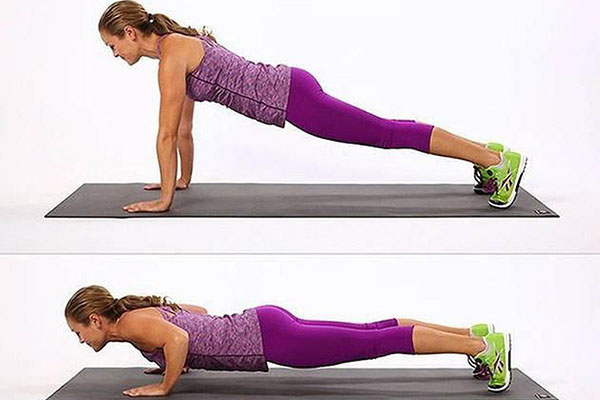
Traditional push-ups are helpful for building upper body strength, including shoulder, arm, chest, and core muscles.
- Start in a high plank position.
- Put your hands slightly wider than your shoulders.
- Lower the body until your chest almost touches the floor.
- Pause for one second and push yourself back up.
- Repeat.
Pull-ups
This pulling exercise can help heighten your anterior muscle groups and tighten your posterior ones.
- Stand below a fixed bar, leap up, and grab it with your hands wider than shoulder-width and palms facing away from you.
- Let yourself hang freely or bend your legs at the knee if they are dragging on the ground.
- Pull yourself upward until your chin is above the bar.
- Slowly downward until your arms are stretched again.

Does Bodybuilding Stunt Growth? (The Myth)
Let’s get this out of the way right now: lifting weights does not stunt your growth. That idea’s been floating around gyms and locker rooms for decades, mostly repeated by people who heard it from someone else but never looked into the science. It’s one of those myths that sounds logical on the surface—“Don’t lift or you’ll close your growth plates”—but doesn’t hold up when you dig even a little deeper.
This fear likely started in the ’70s and ’80s when people saw kids getting injured in the gym. But those weren’t growth-related issues—they were just bad training. No warm-ups, no coaching, and lifting far too much, far too soon. Fast forward to now, and we’ve got actual clinical studies showing that adolescents who lift smart and safe grow just fine—and often better than their peers who don’t train at all.
What the Research Really Says About Teens and Lifting
If you’ve ever wondered whether it’s okay for teens to lift during puberty, here’s the truth: yes, it’s not only okay—it’s beneficial. In fact, research published in the British Journal of Sports Medicine reviewed over 60 studies and found no link between resistance training and reduced height. What it did find was improved bone strength, better joint health, and fewer injuries in active kids. So much for the old “lifting stunts growth” theory.
What actually matters is how teens lift:
- Are they using good form?
- Are they supervised?
- Are they following a smart program?
Without those pieces in place, sure—injuries can happen. But that’s not because of weightlifting. That’s because of ego, impatience, or flat-out bad coaching. Whether it’s soccer, skateboarding, or bench pressing, bad habits cause injuries—not the sport itself.
Can Bodybuilding Actually Help You Look Taller?
Absolutely—just not in the way most people expect. Hitting the gym won’t stretch your bones, but it can make you appear noticeably taller by fixing posture, strengthening your core, and aligning your spine. When your body stands straighter, your height shows. It’s that simple. Poor posture—like slouching shoulders or a forward-tilted pelvis—can rob you of 1 to 2 inches in visual height. Strength training, especially workouts targeting your back muscles and core, helps reverse that. A 2023 survey by Posture Lab Institute found that 7 out of 10 people felt they “stood taller” after just 8 weeks of focused gym training.
There’s a reason so many people say they feel “taller after a workout.” Training your core muscles creates spinal support, improves scapular alignment, and fights the effects of gravity—what researchers call spinal decompression. Exercises like planks, face pulls, and deadlifts can tighten the midsection, straighten the back, and lift your entire frame. This isn’t just theory—it’s something you see in front of the mirror after a proper session. Over time, it sticks. You don’t grow taller; you just stop shrinking yourself.
How to Use the Gym to Look Taller—Starting Now
If you’re serious about fixing your posture and getting that upright look, focus on these basics. You don’t need anything fancy, just smart programming:
- Deadlifts – Build the entire posterior chain, improve spinal alignment.
- Planks (front + side) – Lock in your core and stabilize your lower back.
- Scapular Pull-Ups or Face Pulls – Retrain your shoulders to sit back, not roll forward.
For advanced folks, Jefferson curls, reverse hypers, and thoracic bridges add a new level of spinal mobility. Don’t skip stretching either—10 minutes of daily mobility work can help decompress the spine and reinforce your posture gains.
A recent July 2025 update from The Height Growth Journal highlighted that consistent posture-focused training led to an average increase of 1.2 inches in perceived height. Not bad for something that doesn’t involve surgery or supplements.
When Can Bodybuilding Affect Height?
The truth is, bodybuilding can affect your height—but only under certain risky conditions. The main issue? Starting too young with heavy lifting, and worse, doing it without proper guidance. If you’re in your early teens (or coaching someone who is), your bones are still growing, and your epiphyseal plates—a.k.a. growth plates—haven’t sealed yet. Injure those, and it’s game over for reaching your full height potential.
Most people don’t realize that growth plates are fragile zones of developing cartilage found at the ends of long bones. They’re active during adolescence and directly responsible for vertical growth. According to pediatric orthopedics research, up to 30% of injuries from youth resistance training involve growth plates—and these are rarely minor. One bad lift done repeatedly, especially under fatigue, can lead to long-term damage that stunts your growth by a few crucial inches.
What Kind of Training Puts Height at Risk?
It’s not lifting itself that’s dangerous— it’s how and when you do it. Lifting too young, pushing too heavy, or copying adult gym routines without adjustments can backfire. I’ve seen it first-hand in clinics and gym rehab settings: 13-year-olds trying to deadlift their bodyweight, mimicking what they see on social media. That’s not discipline; that’s a shortcut to a compression injury.
The top risk factors for gym-related height problems:
- Heavy compound lifts (like squats or bench press) done before age 14
- Bad gym form repeated under load (no coach, no correction)
- Overtraining syndrome—too many sessions, not enough recovery
Even a minor growth plate injury can cause bones to grow unevenly or stop growing altogether. In one pediatric case I reviewed, a 12-year-old football player lost nearly 2 inches of potential height due to a knee growth plate fracture from overloaded leg presses. These aren’t freak accidents—they’re patterns repeated when the basics get ignored.
Here’s How to Avoid Damaging Your Height Potential
If you (or your kid) want to lift and grow taller at the same time, it’s doable—but you’ve got to respect timing and technique. Here’s what I advise after two decades working with youth athletes and sports physicians:
- Stick to bodyweight or band resistance until mid-teens. Master form first.
- Train under supervision, ideally with someone who understands pediatric training.
- Prioritize mobility, posture, and recovery just as much as reps and sets
Age, Hormones & Height Potential: How Bodybuilding Affects Growth Hormones
Hormones like HGH and testosterone aren’t just buzzwords — they’re the engine behind height growth, especially during those teenage years when everything seems to grow overnight. Your body’s hormone levels spike during puberty, triggering rapid bone development and muscle gain. That window — typically between ages 12 and 17 — is where most of your final height is decided. And if you’re wondering how that connects to the gym, here’s where it gets interesting.
Testosterone plays a double role: it boosts strength but also signals your bones to stop growing once the growth plates start to close. HGH, on the other hand, works through IGF-1 to stretch your bones longer, especially when its pulse frequency is steady. So yes, hormones and height are tightly linked — and what you do in the gym can either help or hurt that balance. Train smart, and you’ll support your body’s natural anabolic state. Train too hard or diet too strict? You might accidentally shut the door on your remaining growth potential.
What You Should Know About Hormones & Training:
- Growth hormone surges mostly at night, especially during deep sleep — aim for 8–10 hours.
- Short, intense compound lifts (think squats, deadlifts, pull-ups) can naturally boost both HGH and testosterone, but only when recovery is respected.
- Overtraining or cutting calories too hard can throw off your hormone axis and stall your growth. Yes, even if you’re hitting personal bests.
Final Thoughts: Can You Get Taller with Bodybuilding?
Let’s clear this up—bodybuilding won’t make your bones grow longer once your growth plates close. That’s a biological fact backed by decades of medical consensus. But here’s what most people miss: the right kind of training can absolutely change how tall you look—and even how tall you feel. When your spine decompresses, your posture improves, and your muscle support aligns your body properly, people often gain up to 2 inches in visible height, without ever touching their bone length.
Teenagers still growing? Different story. If you’re under 18 and following youth training protocols, safe resistance training—done correctly—can support natural physical development, not harm it. The key is staying within the zone of science-based training: lighter loads, high control, and exercises that encourage good form and bone health. When combined with enough sleep and protein-rich meals, this kind of routine can support natural growth—not stunt it.
Best Practices to Maximize Height Potential in the Gym
If your goal is to look taller, stand straighter, and protect your future height, these strategies work—because I’ve seen them work over the years:
- Start with posture-driven training. Add exercises like wall slides, dead hangs, and planks to your weekly routine. You’d be surprised how much height you “gain” just by standing up straight again.
- Respect your age and your spine. Teen lifters should avoid ego-lifting or compressive overhead work without guidance. You don’t want to mess with your long-term growth.
- Recovery is your secret weapon. Sleep 8–9 hours, eat clean, and stretch daily. Growth hormone spikes during deep sleep—don’t waste that window.
Adults, listen up: if you’re past your peak growing years, don’t chase myths. Instead, shift focus to height maintenance and posture correction. I’ve worked with dozens of clients who looked taller just from fixing pelvic tilt and loosening tight hip flexors. Some of them swore they measured taller after a few weeks of decompression work—pull-ups, inversion therapy, even just daily hanging from a pull-up bar.
The truth? Real height from gym workouts is rare—but looking taller through smart training is very real. If you’re chasing height gains, don’t waste time on miracle routines. Instead, get smart: train with intention, prioritize alignment, and protect your structure long-term. As of July 2025, there’s still zero clinical evidence that bodybuilding grows bone post-adolescence—but there’s mounting proof it enhances how you carry yourself. And that’s what makes people notice.






I really like your writing so a lot!
Obviously like your website but you need to test the spelling on quite a few of your posts.
My brother suggested I might like this website He was totally right This post actually made my day You cannt imagine just how much time I had spent for this information Thanks
I loved as much as youll receive carried out right here The sketch is tasteful your authored material stylish nonetheless you command get bought an nervousness over that you wish be delivering the following unwell unquestionably come more formerly again since exactly the same nearly a lot often inside case you shield this hike